
The Middle East has long been one of the most strategically vital regions for global trade — and in 2026, escalating conflict has created unprecedented pressure on maritime routes essential for the global coffee supply chain. From East Africa to Southeast Asia and the Gulf, exporters, roasters, and importers alike are feeling the shockwaves.
This analysis breaks down how the turmoil is impacting global logistics, why Vietnam is suddenly both vulnerable and advantaged, and what it means for coffee availability in the UAE and other affected markets.
Amid this turbulence, adaptability and diversification will define which businesses emerge stronger in the years ahead.
www.vietrobust.com
1. A Multi‑Front Shipping Crisis Disrupting Global Coffee Flows
Three of the world’s most critical maritime chokepoints — the Strait of Hormuz, the Red Sea/Bab el‑Mandeb, and the Suez Canal — have faced simultaneous disruption since late February and early March 2026.
- Iran's blockade of the Strait of Hormuz halted vessel traffic, triggering energy and freight volatility.
- Renewed Houthi attacks in the Red Sea forced vessels back onto long detours around the Cape of Good Hope, adding 10–14 days of transit time.
- All major carriers — including Maersk, Hapag‑Lloyd, CMA CGM — suspended or rerouted Middle East services, increasing surcharges and insurance premiums.
- Ocean carriers’ decisions are driven by elevated security risks, forcing widespread global scheduling delays.
Since the Middle East handles 12–15% of global trade via the Red Sea and Suez Canal, the coffee industry, heavily reliant on these routes, is experiencing direct and immediate consequences.
2. Why Coffee Is Especially Vulnerable to These Disruptions
The industry’s reliance on predictable shipping schedules makes it uniquely sensitive to route instability.
Higher shipping costs and longer transit times
Freight and insurance surcharges have tripled on some lanes due to “war risk” premiums.
Transiting around Africa adds thousands of nautical miles and extends delivery windows unpredictably. [linkedin.com]
Energy price volatility
With Gulf states supplying ~20% of global oil, disruptions around Hormuz raise fuel costs — a major driver of shipping expenses.
Capacity shortages across the global network
Detours absorb global vessel capacity and container equipment, delaying shipments not only from Africa but also from Asia, including Vietnam and Indonesia. [gcrmag.com]
Quality risks for green coffee
Longer voyages and hot‑humid storage conditions increase the risk of quality degradation.
3. Impact on Vietnam — the World’s Leading Robusta Supplier
Vietnam’s coffee industry is deeply exposed to maritime disruptions, and the Ministry of Industry and Trade has formally warned of elevated trade risks due to Middle East instability.
Key vulnerabilities for Vietnam
- Higher fuel and freight costs, especially on sea and air routes connecting Vietnam to Middle Eastern markets.
- Longer transit times from avoidance of the Red Sea and Hormuz, affecting schedule reliability.
- Airspace restrictions across several Middle Eastern countries have rerouted flights, raising air‑cargo costs.
- Logistics disruptions challenge Vietnam’s exporters, who rely on competitive freight pricing to maintain market share.
Yet, paradoxically, Vietnam is also benefiting in some ways:
A strong global demand surge for Vietnamese robusta
Vietnam posted record‑high coffee export revenue in 2025, with a 67.5% year‑on‑year increase in value—largely due to tight global supply and strong demand from Europe and Asia.
Shift in global blends
As Brazilian supply dropped and freight disruptions raised costs, many roasters have substituted Vietnamese robusta in blends, boosting Vietnam’s importance in the global supply chain.
Thus, Vietnam faces a dual reality: rising export opportunities but growing risks in route reliability and shipping costs.
4. What This Means for Coffee Supply in the UAE and Wider Gulf Region
The UAE is a major re‑export hub for coffee in the Middle East, relying heavily on transit through the Red Sea and the broader Gulf.
Key impacts on UAE coffee supply
1. Delayed shipments and stock uncertainty
With all major carriers rerouting around Africa, the UAE is experiencing longer replenishment cycles and extended lead times.
2. Higher landed costs
Emergency conflict surcharges and elevated bunker fuel costs are pushing up import prices. UAE roasters are already seeing the “geopolitical premium” reflected in green coffee costs.
3. Volatility in availability of East African and Asian coffees
Robusta from Vietnam and arabica from Ethiopia/Kenya are particularly affected due to their dependence on Red Sea and Suez routes.
4. Consumption slowdown
Demand in the Middle East has softened due to economic pressures and regional uncertainty. Some analysts expect temporary suppression in consumption levels.
5. Looking Ahead: How Long Will the Disruptions Last?
While there were brief periods of optimism—such as temporary reductions in Houthi attacks and some carriers exploring limited use of Suez — the renewed escalation in 2026 has reversed progress.
- Carriers continue to avoid Red Sea routes due to ongoing threats. [spglobal.com]
- The Strait of Hormuz remains highly volatile and partially blocked. [mightyshipping.com]
Experts warn that risk will remain elevated for at least the next year unless a sustained ceasefire takes hold.
6. What Coffee Stakeholders Should Prepare For
For Vietnam
- Greater need for route diversification and hedging strategies.
- Potential to expand processed coffee exports (instant, roasted) to reduce dependency on volatile shipping lanes.
- Strong global demand offers upside despite logistics risks.
For UAE and Gulf Markets
- Expect higher prices and periodic supply tightness.
- Roasters may increasingly adjust blends toward more available origins.
- Importers may diversify suppliers beyond Red Sea–dependent regions.
For Global Buyers
- Continued freight volatility into 2026.
- Need for flexible contracts, diversified logistics strategies, and greater inventory buffers.
Conclusion
The Middle East conflict has become one of the most significant disruptions to the global coffee supply chain since the pandemic. With shipping routes in turmoil, supply lines stretched, and fuel costs rising, the entire industry — from farmers in Vietnam and Ethiopia to roasters in Dubai and Hamburg — is navigating a new era of uncertainty.
Vietnam’s role as a stabilizing force in global robusta supply is expanding, but its exporters face mounting logistics challenges. Meanwhile, the UAE and other Gulf nations must prepare for elevated costs and possible shortages as long as Red Sea and Hormuz instability persists.
Amid this turbulence, adaptability and diversification will define which businesses emerge stronger in the years ahead.
Mar 3 Update: How Shipping Lines in Vietnam Are Reacting to the Escalating Middle East Crisis
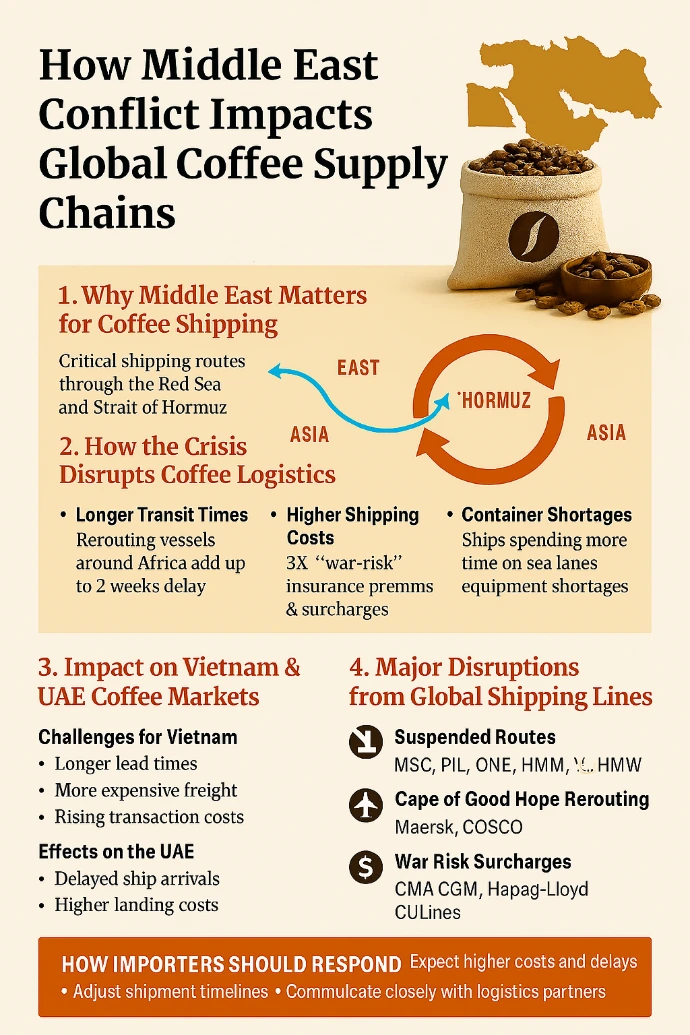
As geopolitical tensions deepen across the Middle East—particularly around the Strait of Hormuz—global shipping lines have enacted widespread operational changes. These rapid adjustments are reshaping transport reliability for coffee exporters and importers, adding yet another layer of uncertainty to an already strained supply chain.
Major Lines Suspend Bookings and Routes
Many carriers have temporarily halted services to the Middle East or stopped transiting the Hormuz corridor altogether.
Several top global lines, including MSC, PIL, ONE, HMM, WHL, OOCL, and COSCO, have paused new bookings to the region, citing heightened security risks and surging insurance costs. Others, such as Evergreen Marine Corporation, have suspended transshipment cargo destined for Dubai and the Red Sea due to escalating threats. These sweeping suspensions further constrict cargo flow and limit the availability of reliable vessel options.
Rerouting Through the Cape of Good Hope
To maintain service continuity while avoiding high‑risk waters, major players such as Maersk and COSCO have redirected vessels around the Cape of Good Hope.
Although safer, this detour adds significant sailing time, extends transit durations, and increases bunker consumption—amplifying the cost pressures already felt across the coffee trade.
War Risk Surcharges Add Further Cost Strain
In addition to longer voyages, shippers are now facing substantial War Risk Surcharges (WRS).
Carriers like CMA CGM, Hapag‑Lloyd, CULines, and Zhonggu Logistics have implemented surcharges ranging from USD 1,500 to over USD 3,200, depending on cargo readiness and routing. These fees apply primarily to cargo yet to be loaded and reflect the rising premiums demanded by insurers for vessels operating near conflict zones.
For coffee shipments—particularly bulk volumes originating from Vietnam and East Africa—these surcharges increase the landed cost for buyers in the UAE, Saudi Arabia, and other Middle Eastern markets already dealing with price volatility and supply uncertainty.
Pending Announcements from Regional and Mid‑Tier Lines
Several regional carriers, including KMTC, Emirates Shipping Line, and Xingya Shipping, have signaled that further updates are forthcoming. This suggests the industry is still bracing for additional operational shocks as the security landscape evolves.
What Businesses Should Do Now
Given the evolving situation, exporters and importers linked to Middle Eastern markets should:
- Reassess shipment timelines and build additional buffer time into all export and import schedules.
- Prepare for extended transit durations, especially for vessels rerouted via the Cape of Good Hope.
- Plan for higher logistics costs, including emergency surcharges and elevated freight rates.
- Maintain close communication with carriers and freight forwarders to secure space and stay informed of last‑minute schedule changes.
These new disruptions underscore the fragility of global coffee logistics. As the conflict continues to reshape shipping routes and increase operational risk, businesses must remain agile, informed, and ready to adapt.