
Part 1 — The Rich History of Vietnamese Coffee: From Colonial Roots to Global Influence
Vietnam’s coffee story is one of resilience, reinvention, and rapid growth. Today, Vietnam stands as the world’s largest producer of robusta coffee—but its journey started over a century ago.
1. The Beginning: Coffee Arrives in Vietnam (1857–1900s)
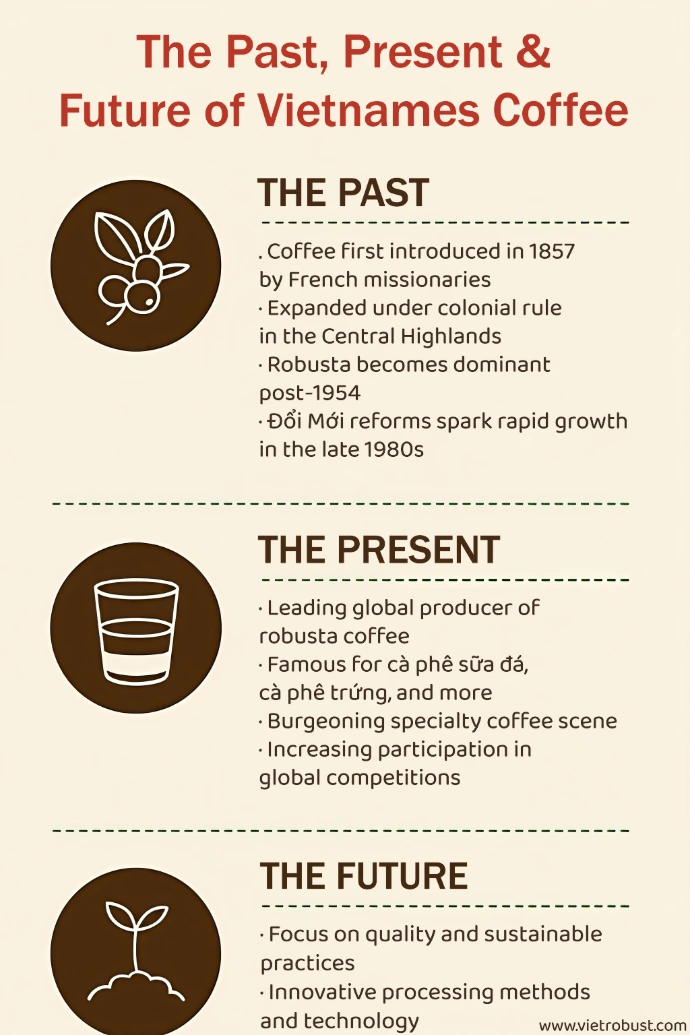
Coffee was first introduced to Vietnam by French missionaries around 1857, beginning with small arabica plantings in Northern Vietnam. Early trials took place in provinces like Ninh Bình, Thanh Hóa, and Nghệ An. However, it wasn't until French colonial expansion that coffee became a commercial crop.
2. Colonial Expansion & the Rise of Plantations (1900–1954)
Under French rule, coffee cultivation expanded into:
- Central Highlands (Tây Nguyên)
- Đắk Lắk, Lâm Đồng, Gia Lai
The Central Highlands’ rich basalt soil proved ideal for large-scale production. By the 1940s, coffee had become a profitable colonial industry, though largely controlled by French planters.
3. War, Hardship & Cooperative Farming (1955–1985)
Post‑1954, Vietnam’s coffee industry faced enormous challenges:
- War disrupted cultivation
- Farms shifted to state-run cooperatives
- Low investment resulted in poor yields
Yet, during this period, robusta became the dominant species due to its resilience and high productivity.
4. Đổi Mới Reforms & the Coffee Boom (1986–2000s)
The turning point came with Đổi Mới economic reforms in 1986:
- Farmers gained land-use rights
- Private coffee plantations emerged
- New processing techniques were introduced
Production exploded from 50,000 tons in the 1980s to over 1 million tons by the early 2000s, making Vietnam the world’s second-largest coffee exporter—a title it still holds today.
Vietnam’s coffee story is a fascinating evolution shaped by history, culture, and global trade.
Part 2 — Vietnamese Coffee Today: A Global Powerhouse With Local Soul
Vietnam’s coffee industry is a unique blend of mass production, cultural richness, and rising specialty innovation.
1. The World’s Largest Robusta Producer
Vietnam supplies 40% of the world’s robusta, powering:
- Instant coffee brands
- Espresso blends
- Commercial roasting giants
Key regions producing robusta today include:
- Đắk Lắk (Buôn Ma Thuột)
- Gia Lai
- Kon Tum
- Đắk Nông
Arabica, while smaller, is thriving in:
- Lâm Đồng
- Sơn La
- Quảng Trị
- Quảng Ngãi (Măng Đen)
2. Coffee Culture: A National Identity
Vietnamese coffee culture is iconic and globally recognized. Highlights include:
Cà phê phin
A slow-drip brewing method delivering a strong, fragrant cup.
Cà phê sữa đá
Vietnam’s signature iced coffee with condensed milk known for its bold sweetness.
Specialty drinks
- Egg coffee (cà phê trứng)
- Coconut coffee (cà phê cốt dừa)
- Salt coffee (cà phê muối)
The café scene in cities like HCMC, Hanoi, and Da Nang is booming, driven by Gen Z, digital nomads, and local entrepreneurs.
3. The Rise of Specialty Coffee
In the last decade, Vietnam has seen:
- Small-batch roasteries
- Third-wave cafés
- Traceable, ethically sourced micro-lots
Farmers are increasingly experimenting with:
- Honey process
- Natural process
- Fermentation techniques
- High-elevation arabica
Vietnam’s specialty scene is now recognized globally, with coffee professionals increasingly participating in World Coffee Championships.
Part 3 — The Future of Vietnamese Coffee: Innovation, Sustainability & Global Expansion
Vietnam’s next coffee chapter will be driven by quality, technology, sustainability, and branding.
1. Moving From Quantity to Quality
Vietnam aims to become known not just as a robusta powerhouse but also a premium producer.
Trends include:
- High-quality robusta (“fine robusta”)
- Specialty arabica expansion
- Improved drying and fermentation practices
This shift will help farmers earn higher margins and reduce vulnerability to commodity price fluctuations.
2. Sustainable Farming & Climate Adaptation
Vietnam faces:
- Climate change
- Soil erosion
- Water scarcity
Solutions being implemented:
- Drip irrigation
- Shade-grown coffee
- Organic farming
- Biodiversity restoration
- Drought-resistant varietals
Government and NGOs are also supporting eco-friendly and regenerative agriculture programs.
3. Technological Transformation
The future of Vietnam’s coffee processing includes:
- IoT-based farm monitoring
- AI-driven yield predictions
- Blockchain traceability
- Solar-powered drying systems
Digital tools will help build transparency—an increasingly important factor for global buyers.
4. Branding Vietnam as a Global Coffee Identity
Vietnam is working toward:
- Country-of-origin branding
- Premium “Vietnamese robusta” positioning
- Expanding international café chains
- Promoting cultural beverages like phin coffee worldwide
As consumer interest in global coffee diversity grows, Vietnam is poised to become a recognized specialty leader.
Conclusion
Vietnam’s coffee industry has traveled an extraordinary path—from colonial beginnings to becoming a global export leader, and now toward a future defined by innovation and sustainable growth.